Fixing the Search Experience
Problem
Online auto parts marketplaces face a unique challenge: they need to collect vehicle details from users before they can display relevant results. This additional decision-making burden on users was driving abandonment by around 35%.
Solution
A conversational search that matches user intent and reduces cognitive load
Results
User churn reduced to around ~15%
Online auto parts marketplaces face a unique challenge: they need to collect vehicle details from users before they can display relevant results. This additional decision-making burden on users was driving abandonment by around 35%.
Solution
A conversational search that matches user intent and reduces cognitive load
Results
User churn reduced to around ~15%
My Role
UX Lead
Team Size: 14
UX Lead: 1
UX Researchers: 2
Writers: 1
UX Designers: 2
Full Stack Developers: 2
Project Manager: 1
Business and Salesforce Consultants: 3-5
UX Lead
Team Size: 14
UX Lead: 1
UX Researchers: 2
Writers: 1
UX Designers: 2
Full Stack Developers: 2
Project Manager: 1
Business and Salesforce Consultants: 3-5
The Problem Explained
Honda Parts is an ecommerce website where users buy official Honda car parts directly from the company. As the UX Lead for the experience at Wipro I was responsible for all interfaces and led the UX strategy. Two UX designers assisted me.
We initially launched Honda Parts in 2021 and began to look closely at critical success metrics.
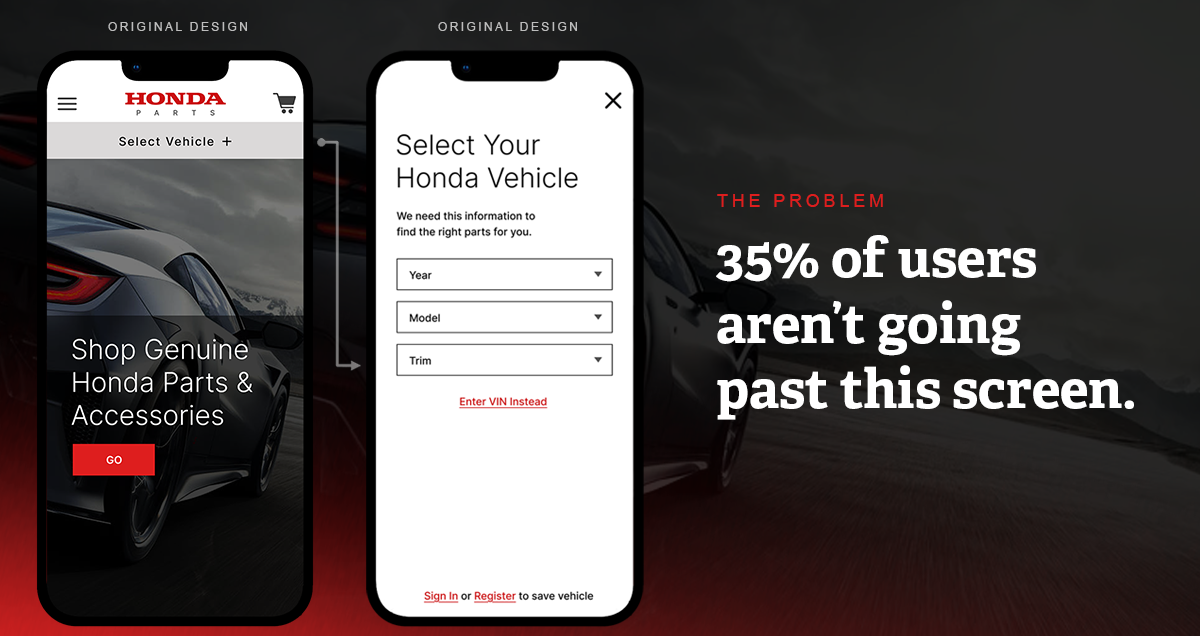
After 3 months, the most egregious stat we noticed is that 35% of users (175k per month) were abandoning our experience at the storefront. While this is a standard bounce rate for ecommerce in general it's abnormally high for a high-intent ecommerce site like Honda Parts.
It was critical to the Honda business to discover WHY.
We initially launched Honda Parts in 2021 and began to look closely at critical success metrics.
After 3 months, the most egregious stat we noticed is that 35% of users (175k per month) were abandoning our experience at the storefront. While this is a standard bounce rate for ecommerce in general it's abnormally high for a high-intent ecommerce site like Honda Parts.
It was critical to the Honda business to discover WHY.
Running The Research
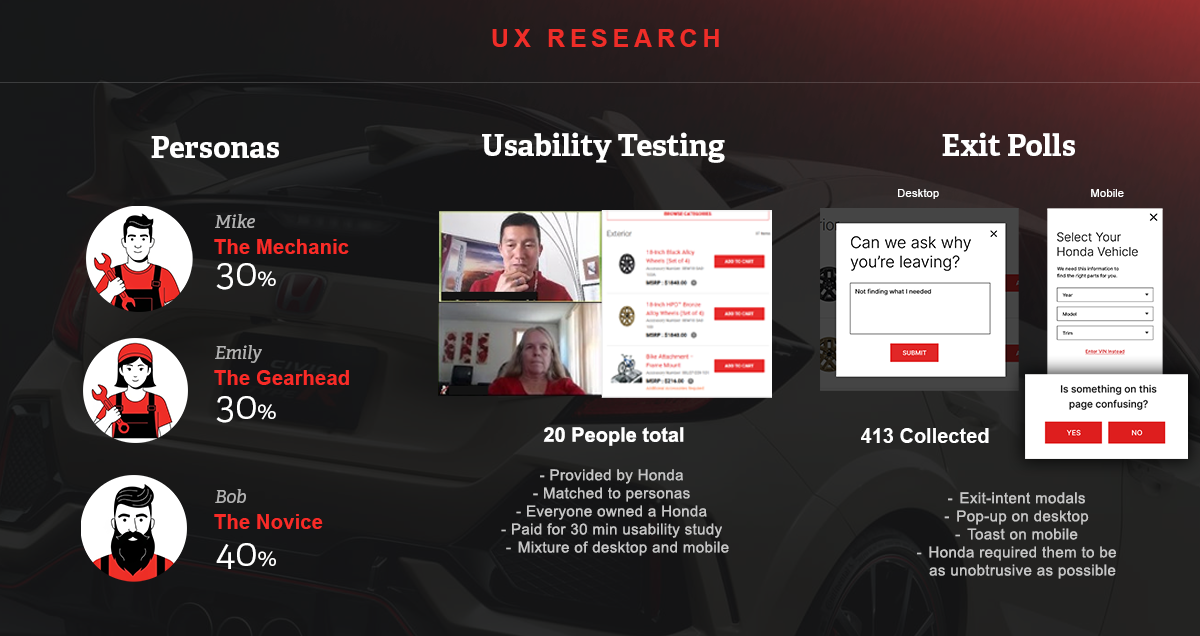
Before getting into new UX research, I should share the previous data gathered in 2019 about our shoppers. They can be broken into 3 personas:
Mike The Mechanic (30%)
Emily The Gearhead (30%)
Bob The Novice (40%)
Mike is a mechanic who needs to find parts for his job. Emily works on cars for fun and can tell you that a 1972 Ford Torino used a carburetor instead of a fuel injector. Bob knows nothing about cars but wants to replace his door handle that broke and hopes to save money by doing it himself.
To learn why we were losing 35% of shoppers on our storefront we employed two methods:
(1) Exit Poll (Exit-Intent Modal)
These don't work well on mobile so we had to create different experiences for mobile and desktop. On desktop we asked users: "Can we ask why you're leaving?" with a simple text input. On mobile if the user hung at the car selection part for 30 seconds we had a toast message ask "Is something on this page confusing?" with Yes/No buttons. If they said "Yes" they were then able to enter an input as to what was confusing.
(2) UX Interviews
Honda was willing to hand us the contact information of about 50 people who would agree to being paid for a quick UX interview where we can watch their screen. It was important to interview someone who had a Honda car and was looking for Honda parts. Because we know of the 30-30-40 split of our personas, we made sure to match our interview pool to the same demographics. In the end we got 20 people signed up. During these interviews we had people go to the storefront and then asked "Can you find a new center console for your car?" "Can you find an electric charger for your car?" (And other questions like this)
Mike The Mechanic (30%)
Emily The Gearhead (30%)
Bob The Novice (40%)
Mike is a mechanic who needs to find parts for his job. Emily works on cars for fun and can tell you that a 1972 Ford Torino used a carburetor instead of a fuel injector. Bob knows nothing about cars but wants to replace his door handle that broke and hopes to save money by doing it himself.
To learn why we were losing 35% of shoppers on our storefront we employed two methods:
(1) Exit Poll (Exit-Intent Modal)
These don't work well on mobile so we had to create different experiences for mobile and desktop. On desktop we asked users: "Can we ask why you're leaving?" with a simple text input. On mobile if the user hung at the car selection part for 30 seconds we had a toast message ask "Is something on this page confusing?" with Yes/No buttons. If they said "Yes" they were then able to enter an input as to what was confusing.
(2) UX Interviews
Honda was willing to hand us the contact information of about 50 people who would agree to being paid for a quick UX interview where we can watch their screen. It was important to interview someone who had a Honda car and was looking for Honda parts. Because we know of the 30-30-40 split of our personas, we made sure to match our interview pool to the same demographics. In the end we got 20 people signed up. During these interviews we had people go to the storefront and then asked "Can you find a new center console for your car?" "Can you find an electric charger for your car?" (And other questions like this)
Analyzing the Data
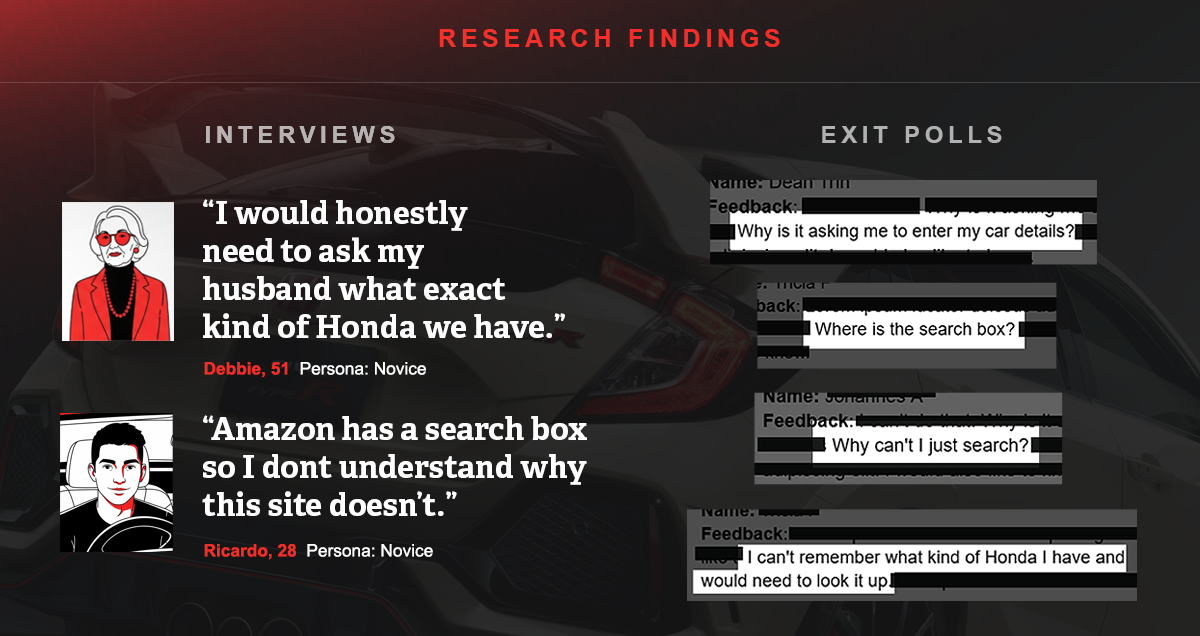
Many users had no issues with the experience but the negative feedback we got via the form and our interviews was pretty consistent:
- "I have no idea my car's model or trim level. I will go find it."
- "Why can't I just search?"
- "Where is the search box?"
- "Why is it asking me to enter my car details?"
- "I can't remember what kind of Honda I have and would need to look it up."
- "I have no idea my car's model or trim level. I will go find it."
- "Why can't I just search?"
- "Where is the search box?"
- "Why is it asking me to enter my car details?"
- "I can't remember what kind of Honda I have and would need to look it up."
60% of our personas (Emily and Mike) had no issue entering their car's details. However, users like Bob (The Novice) were frustrated by the need to specify their car's details.
With every single car containing around 30,000 individual parts, the best way to show users only the results relevant to them is to force them to specify their car at the start. All of our competitors do this (Lexus, Toyota, Subaru) and we have been doing it as well.
But this widely accepted UX feature is also creating a major pain point according to 40% of our users.
What if there was a way to get around it?
But this widely accepted UX feature is also creating a major pain point according to 40% of our users.
What if there was a way to get around it?
Creating A Better Search
After sharing our UX research with Honda they gave us the green light on building a better solution and trying it out with an A-B test. To get feedback on our ideas we created working prototypes and did live ad hoc usability tests with people at Wipro. (Not ideal, but turnaround was tight.)
We initially tried several ideas:
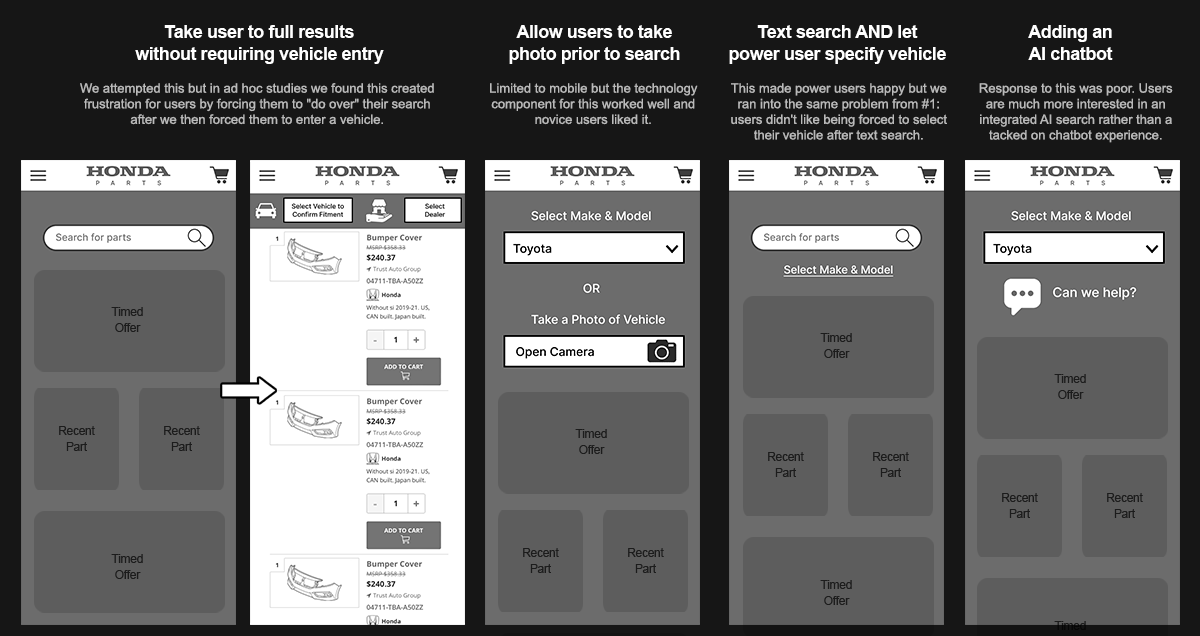
(1) Give users a search box and send them straight to results
User would get a massive amount of "junk" results that often didn't fit their car. Users were frustrated that after search they still had to specify their car in order to guarantee fitment.
(2) Allow users to take a photo of their car instead of a series of selections
Users loved this but it of course only worked on mobile, not desktop.
(3) Give casual users a search box, while advanced users can select model & trim
This solution made power users happy but ran into the same problems with #1 as casual users were getting junk search results.
(4) Keep vehicle selection but add an AI Chatbot
Honda corporate was pushing for this but studies show users increasingly hate chat bots and much prefer an integrated conversational AI search to a chatbot.
We initially tried several ideas:
(1) Give users a search box and send them straight to results
User would get a massive amount of "junk" results that often didn't fit their car. Users were frustrated that after search they still had to specify their car in order to guarantee fitment.
(2) Allow users to take a photo of their car instead of a series of selections
Users loved this but it of course only worked on mobile, not desktop.
(3) Give casual users a search box, while advanced users can select model & trim
This solution made power users happy but ran into the same problems with #1 as casual users were getting junk search results.
(4) Keep vehicle selection but add an AI Chatbot
Honda corporate was pushing for this but studies show users increasingly hate chat bots and much prefer an integrated conversational AI search to a chatbot.
The Breakthrough
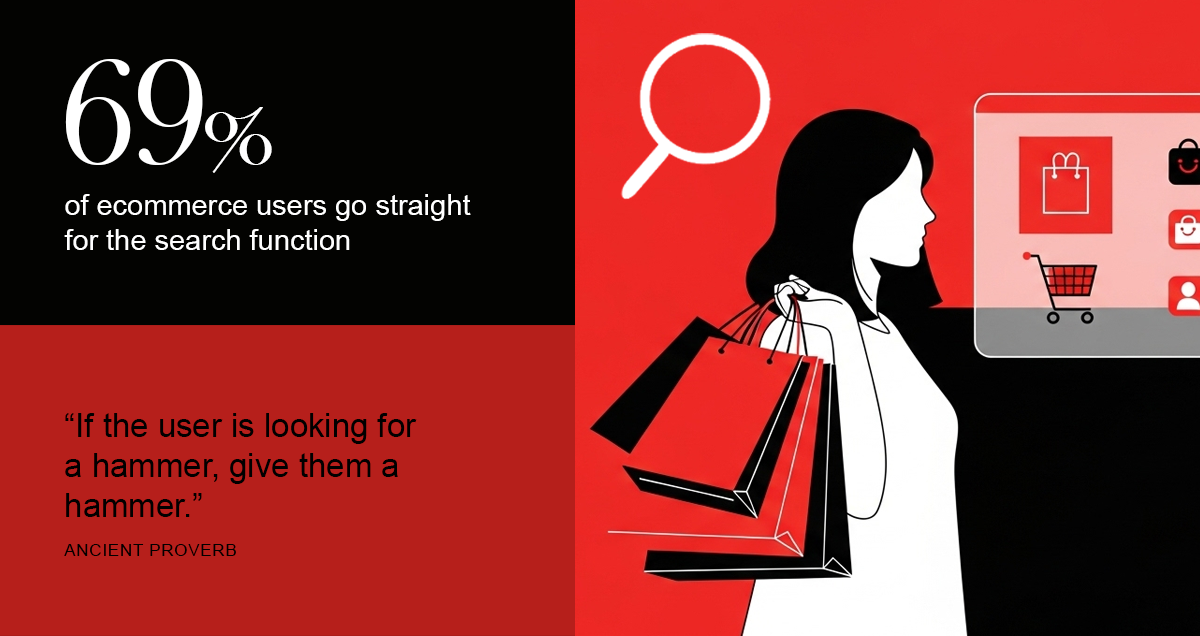
A massive breakthrough came when I read this statistic, confirmed by multiple sources: "69% of ecommerce users go straight for the search bar.".
Of course.
We were asking users to enter dull information about their car when they are looking for a search box. To put this another way: "When a user is looking for a hammer, give them a hammer." As mentioned earlier, we can't send users directly to unfiltered search results but perhaps a conversational AI would be more approachable.
It was.
Our next big challenge was mapping out every possible thing a user could search for and making every journey a good one.
Of course.
We were asking users to enter dull information about their car when they are looking for a search box. To put this another way: "When a user is looking for a hammer, give them a hammer." As mentioned earlier, we can't send users directly to unfiltered search results but perhaps a conversational AI would be more approachable.
It was.
Our next big challenge was mapping out every possible thing a user could search for and making every journey a good one.
The Challenge
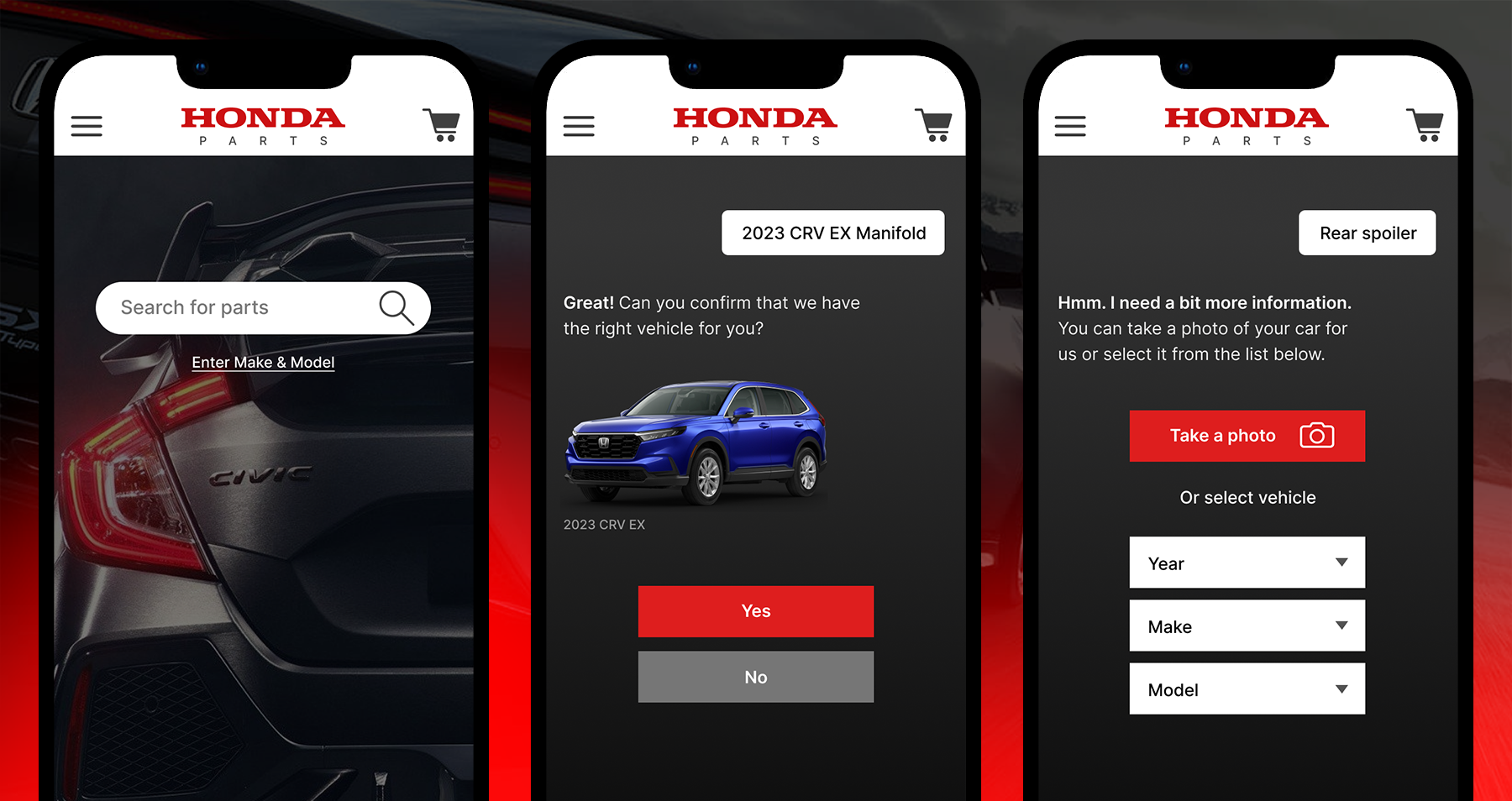
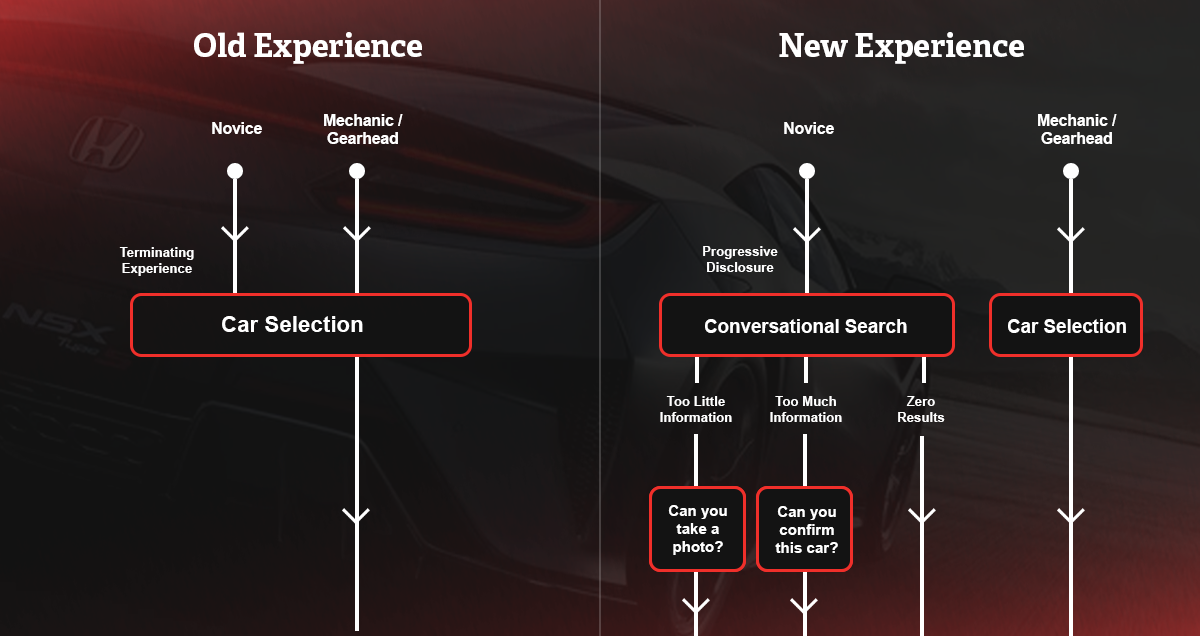
The way we began to look at search is the way all companies should look at a complex search: a conversational advisor who asks clarifying question and seeks to help the user get to their destination.
Here are a few of our use cases taken from actual user searches:
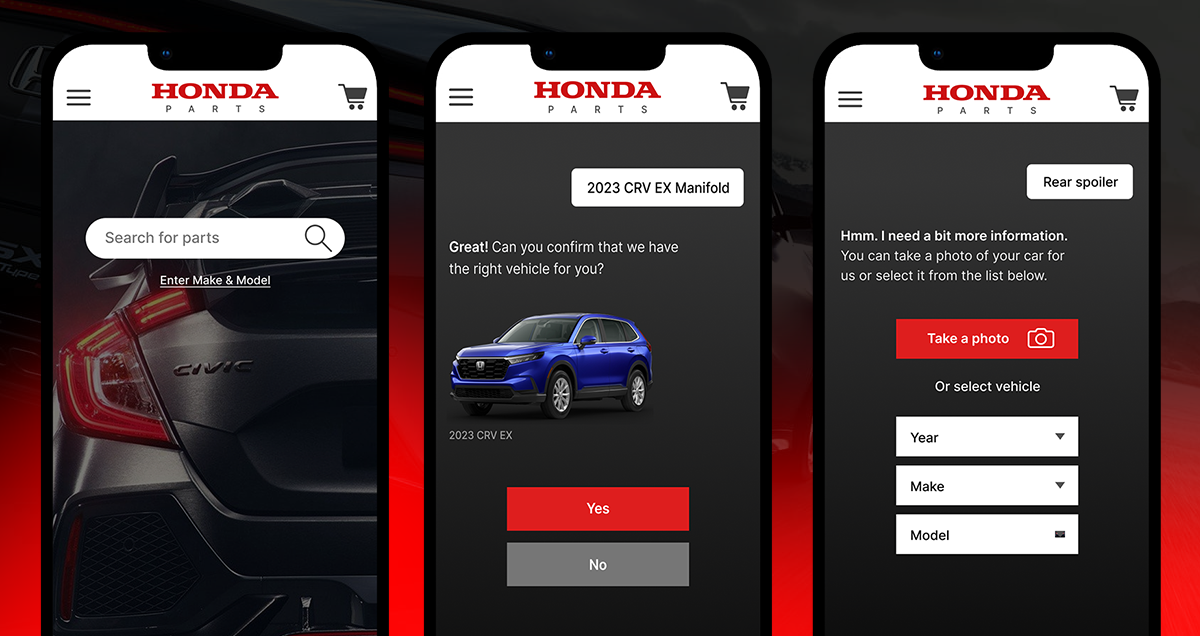
"Rear spoiler" / "Brake Light" (Too Little Information)
"Hmm. I need a bit more information. You can take a photo of your car for us or select it from the list below"
"2022 CRV EX Manifold" (Enough information)
"Great! Can you confirm that we have the right vehicle for you?" We were legally required to confirm vehicle fitment before we could take them to the next screen. Users liked the conversational format.
"Rav 4 Fuel Injector" (Missing Information)
"We have those in stock. I will need your vehicle's trim and year to take you to the right one."
Zero results
"I wasn't able to find anything. Can you specify your vehicle and I'll take you to a grid of likely products?"
Here are a few of our use cases taken from actual user searches:
"Rear spoiler" / "Brake Light" (Too Little Information)
"Hmm. I need a bit more information. You can take a photo of your car for us or select it from the list below"
"2022 CRV EX Manifold" (Enough information)
"Great! Can you confirm that we have the right vehicle for you?" We were legally required to confirm vehicle fitment before we could take them to the next screen. Users liked the conversational format.
"Rav 4 Fuel Injector" (Missing Information)
"We have those in stock. I will need your vehicle's trim and year to take you to the right one."
Zero results
"I wasn't able to find anything. Can you specify your vehicle and I'll take you to a grid of likely products?"
Massive Success
Our revolutionized search engine was tested using an A-B homepage test on the Honda Parts site and was massively successful. User bounce rates dropped from around 35% to around 15%. There was a major spike in AOV, RPV, and CLV numbers.
Honda adopted this as their main search for Honda Parts and there was talk of introducing this system to their other sites.
Honda adopted this as their main search for Honda Parts and there was talk of introducing this system to their other sites.
After the update about 1.2 million users per YEAR were staying in our experience rather than churning - that's huge.
I was thankful for all the hard work our team put into solving this complex business problem. Honda was able to give millions of users a better experience.